Honouring Caritas healthcare workers in Gaza
22 October 2026
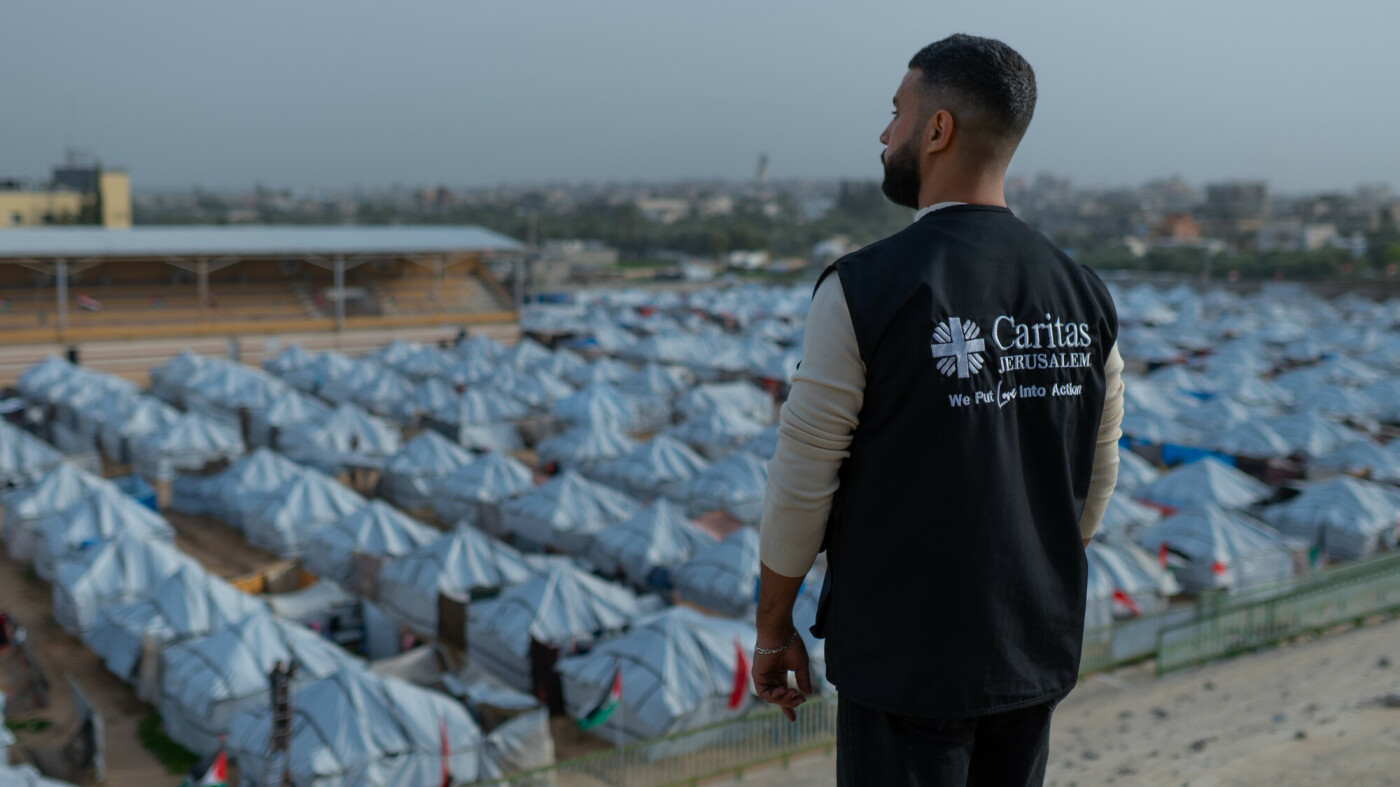
This article was written by our partners at Caritas Jerusalem as a way of displaying their deep respect for their healthcare workers in Gaza who do all they can to help others despite deep fear and grief.
Every morning in Gaza, Caritas healthcare workers wake up carrying the same fears, losses, and uncertainties as the communities they serve. They have lost homes, loved ones, livelihoods, and a sense of safety. Yet every day, they put on their uniforms, open clinic doors, and continue caring for others.
Behind every patient treated is a healthcare worker who is fighting a battle of their own.
A recent survey among Caritas Jerusalem's Gaza staff revealed the staggering toll the war has taken on those who remain at the forefront of humanitarian service. With a response rate of 93.6%, the findings offer a rare glimpse into the reality endured by healthcare workers who continue to heal others while living through the same tragedy themselves.
Many have been forced to flee repeatedly. On average, staff members have been displaced almost six times since the outbreak of the conflict, with some enduring as many as twenty separate displacements. They move from one temporary shelter to another, carrying what little remains of their lives, uncertain of where they will sleep next or whether they will ever return home.
For many, home no longer exists.
More than 70% reported that their houses had been partially damaged, while over a quarter said their homes had been completely destroyed. Nearly seven in ten lost their family's primary source of income. For countless families, daily life has become a struggle to secure food, water, medicine, and shelter.
Yet these are not simply statistics.
They are parents trying to comfort frightened children while hiding their own fear. They are sons and daughters mourning family members while showing strength for those around them. They are healthcare workers treating patients all day and returning at night to tents, overcrowded shelters, or damaged homes.
The human cost has been devastating.
During the war, a Caritas pharmacist and a laboratory technician were killed alongside their families. Nearly one in five staff members suffered injuries themselves. Almost a third lost first-degree relatives. Nearly three-quarters lost second-degree relatives. An overwhelming majority lost friends and former classmates.
Perhaps one of the most heartbreaking findings was that two-thirds of respondents reported losing a family member because healthcare was simply inaccessible when it was needed most.
These losses leave wounds that are not visible.
The survey revealed extraordinarily high levels of stress, emotional exhaustion, helplessness, and psychological strain among staff. Many reported feeling overwhelmed by circumstances beyond their control and uncertain about how to cope with the relentless challenges surrounding them.
And yet, despite everything, they continue to serve. They treat wounds while carrying wounds of their own. They comfort grieving families while grieving themselves. They support the displaced while living in displacement. They encourage people not to lose hope while struggling every day to preserve their own.
Many arrive at work after sleepless nights. Some worry about relatives left behind in dangerous areas. Others wonder how they will provide food for their families. Yet patients are welcomed with kindness, compassion, and dignity.
This is what makes their service extraordinary.
At Caritas Jerusalem, we often refer to our colleagues in Gaza as heroes. Not because they perform dramatic acts. Not because they seek recognition.
They are heroes because they continue to give when they have almost nothing left to give.
They continue to choose compassion over despair, service over surrender, and hope over hopelessness.
Their commitment goes far beyond professional duty. It is a profound expression of humanity and solidarity. It is the quiet courage of people who refuse to turn away from suffering, even when they are suffering themselves.
Recognizing both their sacrifice and the immense emotional burden they carry, Caritas Jerusalem recently organized a Staff Well-being Open Day for team members in Gaza.
For one day, the caregivers became the ones receiving care.
For one day, there were moments of laughter instead of anxiety, conversations that were not about emergencies, and activities that allowed staff to reconnect with themselves and with one another.
Designed from a Mental Health and Psychosocial Support (MHPSS) perspective, the event created a safe space for rest, self-expression, social connection, and emotional relief. Through recreational and creative activities, staff were able to step away, even briefly, from the realities that have dominated their lives for so long.
The smiles, laughter, and enthusiasm witnessed throughout the day were powerful reminders of something often forgotten in humanitarian crises: even the strongest people need support.
The event was not simply recreational. It was an acknowledgment. An acknowledgment that those who spend their days caring for others deserve care themselves. An acknowledgment that resilience does not mean invulnerability. An acknowledgment that behind every healthcare worker is a human being carrying pain, hopes, fears, and dreams.
Of course, one day cannot erase months of grief, trauma, displacement, and loss.
It cannot rebuild destroyed homes. It cannot bring back loved ones. It cannot remove the uncertainty of tomorrow. But it can provide something equally important: a moment to breathe. A moment to feel seen. A moment to remember that they are not alone.
As Caritas Jerusalem continues its mission in Gaza, supporting the well-being of healthcare workers remains as important as supporting the communities they serve. Those who stand on the frontlines of compassion need opportunities to rest, recover, and find strength to continue their life-saving work.
The story of Caritas healthcare workers in Gaza is not only a story of suffering.
It is a story of courage when fear would be understandable. Of compassion when bitterness would be easy. Of hope when despair seems overwhelming.
Every day, they choose to heal while hurting, to serve while struggling, and to stand beside their communities when the need is greatest.
For that, they deserve more than our gratitude.
They deserve our admiration, our support, and our deepest respect.
Because even under fire, they continue to be a light for others.

Gaza lies along the Mediterranean coast, yet safe water has become painfully scarce. What once sustained daily life has become unsafe.

With all eyes on fresh conflicts in the Middle East, it’s easy to forget about the people of Gaza. But we cannot.

Across the Middle East, humanitarian needs are rapidly evolving as regional tensions escalate.
Back to